Distribution Models for Local Food

Posted January 2009

Eating locally is going mainstream. For years, committed eaters have gone out of their way to source local food from farmers’ markets, farms, roadside stands and Community Supported Agriculture drop-off sites. With more and more people wanting to incorporate local food into their meals, however, how do we make local food affordable and convenient for everyone?

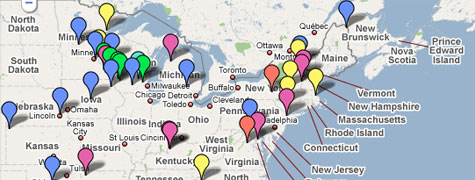
With support from the Ira and Ineva Reilly Baldwin Wisconsin Idea Endowment, CIAS is researching distribution models for local food. Across the United States, entrepreneurs, cooperatives and nonprofits are filling an important missing link in local food systems: aggregating food from local farms and distributing it to stores, restaurants, eaters and other retailers and end users. We have created a map of some of these distribution models. Go to the full-sized map for a list of the models and detailed descriptions.
View Larger Map

We are in the process of creating in-depth case studies of some of these distribution models. We will post them on this website soon.

Vegetable Storage Crops Workshop

Learn how to extend your marketing season by growing and selling winter storage crops like carrots, beets, winter squash, cabbage, potatoes, onions, garlic and more. This workshop will be held on December 4 in Hudson and December 11 in Madison. For details, see the workshop flyer. Hope to see you there!


CIAS in the community

CIAS Hosts Annual Meeting of Eco-Apple Growers

On Thursday, November 12, CIAS hosted its annual meeting of apple growers engaged in its Eco-Apple pesticide reduction program. Notably, the group of 48 growers celebrated the successful completion of a six-year effort designed to reduce the use of pesticides on orchards throughout Wisconsin. During the course of the program, all reporting orchards demonstrated a reduced reliance on pesticides in favor of a diversity of IPM strategies, and some realized a near-total elimination of organophosphate applications. CIAS thanks its team of growers for their enthusiastic and committed participation. In particular, CIAS wishes to thank Dave Flannery, Wendy Schafer, Bill Stone and Anna Maenner for their fortitude in seeing this phase of the project through to a successful conclusion. UW rsearchers Dan Mahr, Patty McManus, Matt Stasiak and Teryl Roper have been critical to the project’s success. Thanks also to EPA-V and the USDA for their support and encouragement.

[More posts...]