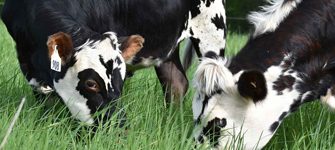
Extension Publication Answers Consumers’ Quesions About Grass-Fed Beef

Posted April 2009

Farmers use a variety of systems to raise healthy animals. Today, most meat in the grocery store or at the local restaurant is from animals that were raised in a feedlot and fed significant amounts of grain in addition to hay and pasture. Grass-fed meat is from animals that are put “out on grass,” or fed a forage diet. This allows animals to harvest their own food and dispose of their own manure in the pasture.

A consumer’s guide to grass-fed beef provides information about the health and environmental benefits of grass-fed beef and how to buy and cook this beef. It includes several recipes. This publication was developed by UW-Extension Emerging Agricultural Markets Team and the Wisconsin Department of Agriculture, Trade and Consumer Protection. It is available for download or purchase from Cooperative Extension Publications—The Learning Store.

A consumer’s guide to grass-fed beef [PDF]

Vegetable Storage Crops Workshop

Learn how to extend your marketing season by growing and selling winter storage crops like carrots, beets, winter squash, cabbage, potatoes, onions, garlic and more. This workshop will be held on December 4 in Hudson and December 11 in Madison. For details, see the workshop flyer. Hope to see you there!


CIAS in the community

CIAS Hosts Annual Meeting of Eco-Apple Growers

On Thursday, November 12, CIAS hosted its annual meeting of apple growers engaged in its Eco-Apple pesticide reduction program. Notably, the group of 48 growers celebrated the successful completion of a six-year effort designed to reduce the use of pesticides on orchards throughout Wisconsin. During the course of the program, all reporting orchards demonstrated a reduced reliance on pesticides in favor of a diversity of IPM strategies, and some realized a near-total elimination of organophosphate applications. CIAS thanks its team of growers for their enthusiastic and committed participation. In particular, CIAS wishes to thank Dave Flannery, Wendy Schafer, Bill Stone and Anna Maenner for their fortitude in seeing this phase of the project through to a successful conclusion. UW rsearchers Dan Mahr, Patty McManus, Matt Stasiak and Teryl Roper have been critical to the project’s success. Thanks also to EPA-V and the USDA for their support and encouragement.

[More posts...]