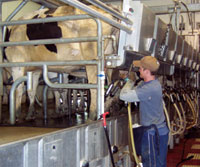
Milking More than Profit: Life Satisfaction on Wisconsin Dairy Farms

Posted August 2007

milking parlor

The number of dairy farms in Wisconsin has been declining steadily for years. This decline has inportant implications for the economic, ecological and social sustainability of communities, families and individuals in Wisconsin. Life satisfaction is one important social consideration in agriculture. Without offering a satisfying life, even the most profitable and ecologically sound forms of agriculture will not be sustainable. Farmers and policymakers need to consider life satisfaction when making decisions about farming. This report presents the results of the 2006 Life Satisfaction and Dairy Farming survey of 1,300 Wisconsin dairy farmers on both grazing and confinement farms.

Key results include:

  • The level of life satisfation varied by dairy farm.
  • Farmers using different dairy farm systems evaluated life satisfaction differently.
  • Men and women on dairy farms used different criteria for evaluating life satisfaction.
  • Differences in life satisfaction between dairy farms were not just a matter of money.

Read this report (pdf file)

Read a summary of this report (pdf file)

Life Satisfaction on Grazing Dairy Farms in Wisconsin (pdf file)

Vegetable Storage Crops Workshop

Learn how to extend your marketing season by growing and selling winter storage crops like carrots, beets, winter squash, cabbage, potatoes, onions, garlic and more. This workshop will be held on December 4 in Hudson and December 11 in Madison. For details, see the workshop flyer. Hope to see you there!


CIAS in the community

CIAS Hosts Annual Meeting of Eco-Apple Growers

On Thursday, November 12, CIAS hosted its annual meeting of apple growers engaged in its Eco-Apple pesticide reduction program. Notably, the group of 48 growers celebrated the successful completion of a six-year effort designed to reduce the use of pesticides on orchards throughout Wisconsin. During the course of the program, all reporting orchards demonstrated a reduced reliance on pesticides in favor of a diversity of IPM strategies, and some realized a near-total elimination of organophosphate applications. CIAS thanks its team of growers for their enthusiastic and committed participation. In particular, CIAS wishes to thank Dave Flannery, Wendy Schafer, Bill Stone and Anna Maenner for their fortitude in seeing this phase of the project through to a successful conclusion. UW rsearchers Dan Mahr, Patty McManus, Matt Stasiak and Teryl Roper have been critical to the project’s success. Thanks also to EPA-V and the USDA for their support and encouragement.

[More posts...]