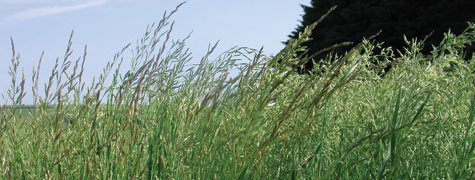
Forage Fescues in the Northern USA

Posted October 2008

Tall fescue, meadow fescue and festulolium have potential value as forages for grazing operations in the northern USA. Meadow fescue is the most cold tolerant of these grasses, with excellent forage quality and palatability, and relatively high drought tolerance. Tall fescue has the highest yield potential, good palatability for soft-leaf varieties and excellent heat and drought tolerance. Festulolium exhibits high forage quality and good summer production. This publication focuses on the use and culture of meadow fescue, tall fescue and festulolium, with additional information on their history and introduction to North America.

Read this report (PDF)

Read a two-page summary of this report (PDF)

Vegetable Storage Crops Workshop

Learn how to extend your marketing season by growing and selling winter storage crops like carrots, beets, winter squash, cabbage, potatoes, onions, garlic and more. This workshop will be held on December 4 in Hudson and December 11 in Madison. For details, see the workshop flyer. Hope to see you there!


CIAS in the community

CIAS Hosts Annual Meeting of Eco-Apple Growers

On Thursday, November 12, CIAS hosted its annual meeting of apple growers engaged in its Eco-Apple pesticide reduction program. Notably, the group of 48 growers celebrated the successful completion of a six-year effort designed to reduce the use of pesticides on orchards throughout Wisconsin. During the course of the program, all reporting orchards demonstrated a reduced reliance on pesticides in favor of a diversity of IPM strategies, and some realized a near-total elimination of organophosphate applications. CIAS thanks its team of growers for their enthusiastic and committed participation. In particular, CIAS wishes to thank Dave Flannery, Wendy Schafer, Bill Stone and Anna Maenner for their fortitude in seeing this phase of the project through to a successful conclusion. UW rsearchers Dan Mahr, Patty McManus, Matt Stasiak and Teryl Roper have been critical to the project’s success. Thanks also to EPA-V and the USDA for their support and encouragement.

[More posts...]